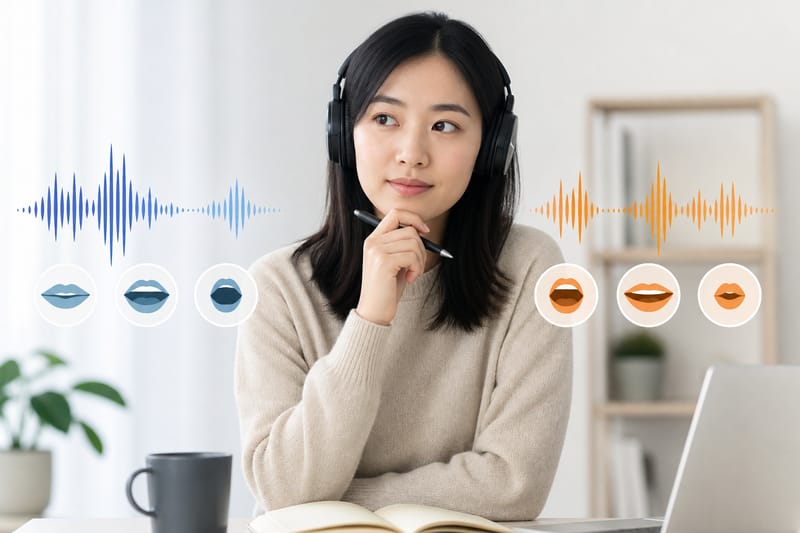
Pronunciation
Can an AI Tutor Correct Your English Pronunciation? What It Actually Catches
Can an AI tutor correct your English pronunciation? The short answer is yes, and it does something a human tutor rarely does: it scores every word you say, every time. Here is what speech recognition genuinely catches, what it still misses, and how to get the most out of it.
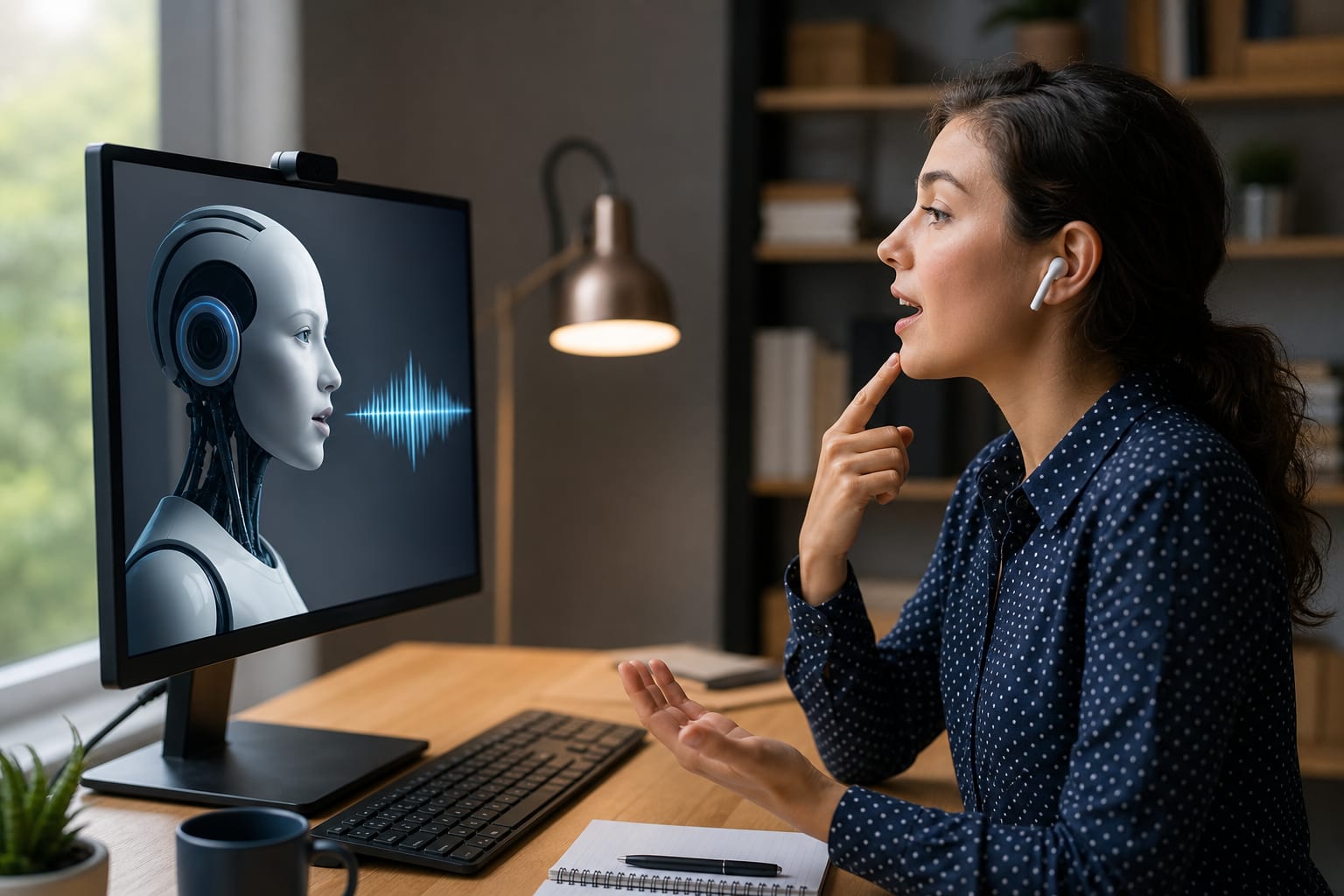
Speech recognition now scores pronunciation with enough precision to tell the difference between "ship" and "sheep", "walk" and "work", "think" and "sink". That is not a marketing claim; it is the result of a decade of work on sound-level assessment in automatic speech recognition systems. The question is no longer whether the technology exists. The question is what it is actually good for and where it quietly lets you down. So can an AI tutor correct your English pronunciation? The honest answer is yes, with real caveats worth understanding.
What does an AI tutor actually hear?
When you speak into an AI tutor, you are not talking to a person who is listening. You are talking to a model that has been trained on thousands of hours of native and non-native speech, and that model is comparing your audio to a statistical map of how each sound should be produced. It is not guessing based on vibes. It is measuring acoustic features: vowel length, formant frequencies, where your tongue probably is, whether a consonant was voiced or not.
This is why the feedback can be so specific. A modern pronunciation engine does not just return "try again". It returns "the vowel in 'bit' was too long, you produced something closer to 'beat'". That level of granularity is the whole point of the technology, and it is the reason the answer to "can an AI tutor correct your English pronunciation" has shifted from a cautious maybe to a confident yes in the last few years.
Research on automatic pronunciation assessment has focused heavily on this sound-level scoring, because it is what makes feedback actionable. A single pass/fail tells you nothing. A per-sound breakdown tells you exactly what to fix. You can read more about how these systems are evaluated in the research literature on computer-assisted pronunciation training, which consistently finds that sound-level feedback improves learner outcomes more than holistic scoring.
There is a real limit to be honest about here. The AI hears an acoustic signal, not your mouth. It can tell you the sound is wrong, but it cannot watch your lips, see that your jaw is too tight, or notice that you are not rounding your lips on the "oo" sound. That physical coaching is still a human skill, and no amount of audio processing replaces it.
Why per-word feedback beats a single score
Imagine two learners. The first records herself reading a sentence and gets back "72%". The second records the same sentence and gets back a word-by-word breakdown: "good" on four words, "fair" on one, "poor" on another, with the poor word highlighted and its exact problem sound identified.
The second learner knows precisely what to practise tomorrow. The first learner knows she is "okay", which is not a piece of information, it is a feeling. This is the single biggest argument for AI pronunciation feedback over the kind you get from a recording app or a human tutor who is trying to be polite. Specificity turns feedback into a plan.
Practice English with AI and you will notice this immediately: the tutor scores your pronunciation live, per word, as good, fair or poor, and it does this inside the same conversation where you are learning the word. There is no separate "pronunciation lab" you have to remember to visit. The correction happens in the moment you need it, which is when it actually sticks.
There is a deeper reason this matters. Pronunciation errors are almost never evenly distributed across everything you say. Most learners have a handful of problem sounds: the "th" sounds, the short "i" versus long "ee", final consonants that get swallowed. A single overall score hides that pattern. Per-word scoring reveals it, and once you can see the pattern, you can target it instead of practising everything at random.
What AI pronunciation feedback still misses
Honesty matters more than enthusiasm here, because if you expect an AI tutor to do everything, you will be disappointed and quit. So here is what it does not do well.
First, connected speech. When native speakers talk, words run into each other: "want to" becomes "wanna", "going to" becomes "gonna", and the final consonant of one word often attaches to the start of the next. Most pronunciation engines are trained on isolated words or carefully read sentences, and they can struggle with the fluid mush of real conversation. If you speak naturally and fast, the AI may flag a word as "poor" not because you said it wrong but because you said it the way a native would.
Second, intonation and rhythm. Some systems measure stress and pitch, but it is a much harder problem than segmental accuracy. The melody of a question, the emphasis that changes meaning ("I didn't SAY that" versus "I didn't say THAT"), the rhythm that makes English sound English rather than like your first language with English words: these are still difficult for machines to assess reliably.
Third, the physical side. A good human pronunciation teacher will tell you to put your tongue between your teeth for "th", to smile slightly for the long "ee", to drop your jaw for "ah". An AI can only infer these things from the sound you made. It cannot correct your posture, and for some learners, especially those whose first language does not contain a particular sound at all, the physical instruction is the only thing that works.
How to use AI pronunciation feedback without forming bad habits
The risk with any instant-feedback tool is that you become dependent on it, or worse, that you train yourself to game it. Here is how to use an AI tutor's pronunciation scoring so it builds your skill instead of replacing it.
First, use the feedback to build a personal list of problem sounds. Every time the AI flags a word as "poor", note the sound it points to. After a week, you will have a short list of maybe five or six sounds that account for most of your errors. That list is your actual curriculum. Practising those sounds deliberately for ten minutes a day will do more than an hour of unfocused speaking.
Second, do not chase a perfect score on every word. The goal is intelligibility, not a flawless native accent. If the AI marks a word "fair" and you know a real person would understand you, that is often good enough. Obsessing over the last ten percent of accent reduction has a poor return on time, and it can make you self-conscious in ways that hurt fluency. The research on intelligibility versus accentedness is clear: being understood is the goal, sounding native is a bonus.
Third, combine the AI feedback with shadowing. Listen to a native speaker, say the sentence immediately after, and let the AI score your attempt against the original. This loop of listen, speak, compare, correct is dramatically more effective than either activity alone, because the AI gives you the objective measurement that your own ear cannot provide.
Tutoro's AI tutor scores your pronunciation word by word as you speak, flagging each word as good, fair or poor right inside the lesson conversation. It suits learners who want a fast, objective feedback loop on specific sounds without waiting for a human teacher. It is not a substitute for a pronunciation coach if your problem is physical, like tongue placement or lip rounding, but for the most common errors it gives you the specific, repeatable feedback that builds a habit.
Does AI pronunciation feedback make you more confident?
This is the part of the question people rarely ask, and it may matter more than the accuracy of the scoring. One of the biggest barriers to speaking practice is fear of judgement. Learners who will happily read, write, and listen freeze when it is time to speak, because every mistake feels like a public failure.
An AI tutor removes the audience. There is no one to be embarrassed in front of, no teacher sighing, no classmate smirking. You can mispronounce "vegetable" forty times in a row and the AI will correct you the forty-first time with exactly the same patience it had the first. That is not a trivial feature; for anxious learners it is the difference between practising and not practising.
The counterargument is worth stating too. Some learners need the social pressure of a real conversation to motivate them, and a machine that never judges can feel too low-stakes to take seriously. The honest answer is that AI feedback lowers the emotional cost of practice, which helps beginners and anxious learners build a base, while human conversation remains the place where that base gets tested under real conditions.
There is also a confidence effect that comes from the feedback itself. When you can see, objectively, that you said eight out of ten words correctly, the two errors feel manageable instead of overwhelming. The score turns a vague feeling of "my pronunciation is bad" into a concrete, shrinking list of things to fix. That reframing alone is worth a lot.
Can an AI tutor correct your English pronunciation? The verdict
So, can an AI tutor correct your English pronunciation? Yes, and for most learners it is the single most efficient tool available for the job. It gives you per-word, per-sound feedback in real time, it never gets tired or embarrassed, and it turns your errors into a visible, shrinking list you can actually work through.
It is the right tool if you are a beginner or intermediate learner who needs volume of speaking practice with objective feedback, if you are anxious about speaking in front of people, or if you have specific problem sounds you want to isolate and fix. Tutoro gives you that feedback loop at a pace no human teacher can match, because it listens to every word of every sentence, every time.
It is the wrong tool, or at least an incomplete one, if your pronunciation problem is physical and you need someone to show you where to put your tongue, or if your goal is to master the rhythm and melody of connected native speech. For those, you still want a human coach, ideally one who specialises in phonetics. The technology behind pronunciation scoring is improving fast, but it is not there yet on intonation.
The smartest way to use it is as the daily feedback engine, with a human conversation partner as the weekly test. You do the volume and the correction with the AI, then you find out in real conversation whether it has actually transferred. That combination gets you the specificity of machine feedback and the unpredictability of human speech, and it is a far better plan than relying on either one alone.
Pronunciation is the one skill where you cannot hear your own mistakes. An AI tutor fixes that by being the mirror you could never hold up to your own voice.
Common questions
Can an AI tutor really correct my English pronunciation accurately?
Yes, for individual sounds and words. Modern speech recognition scores pronunciation at the sound level, so it can tell the difference between similar sounds like 'ship' and 'sheep' and flag exactly which sound is wrong. It is less reliable at judging intonation, rhythm, and connected speech.
Is AI pronunciation feedback better than a human tutor?
For volume and specificity, yes. An AI scores every word you say, every time, and gives a per-word breakdown instead of a single overall mark. A human tutor is still better for physical coaching, like showing you where to place your tongue, and for judging the natural rhythm of connected speech.
What does AI pronunciation feedback miss?
It struggles with connected speech, where words run together as natives speak them, and with intonation and sentence rhythm. It also cannot see your mouth, so it cannot correct physical issues like lip rounding or tongue placement that a human teacher could show you directly.
How should I use AI pronunciation feedback to improve?
Use it to build a short list of your recurring problem sounds, then practise those deliberately for ten minutes a day. Combine it with shadowing: listen to a native speaker, repeat the sentence, and let the AI score your attempt. Don't chase a perfect score on every word, since intelligibility matters more than a flawless accent.
Will practising pronunciation with an AI make me more confident speaking?
Yes, because it removes the fear of judgement. You can mispronounce a word dozens of times with no embarrassment, and the objective per-word scoring turns a vague feeling of 'my accent is bad' into a manageable list of specific sounds to fix.