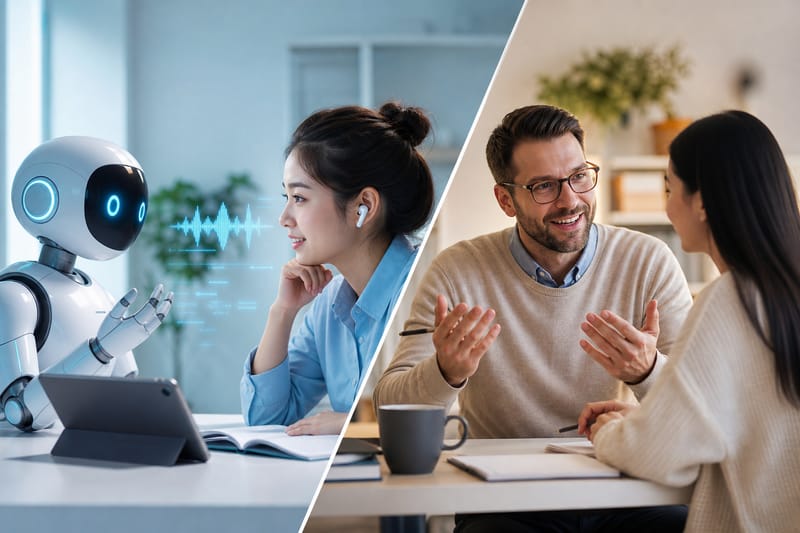
Speaking & Fluency
How AI Can Help You Practise English Speaking (Without the Fear of Judgement)
How AI can help you practise English speaking is no longer a theoretical question. AI tutors now listen to your pronunciation, respond to what you actually say, and let you speak as badly as you need to while you improve. Here is what works, what does not, and how to use it well.
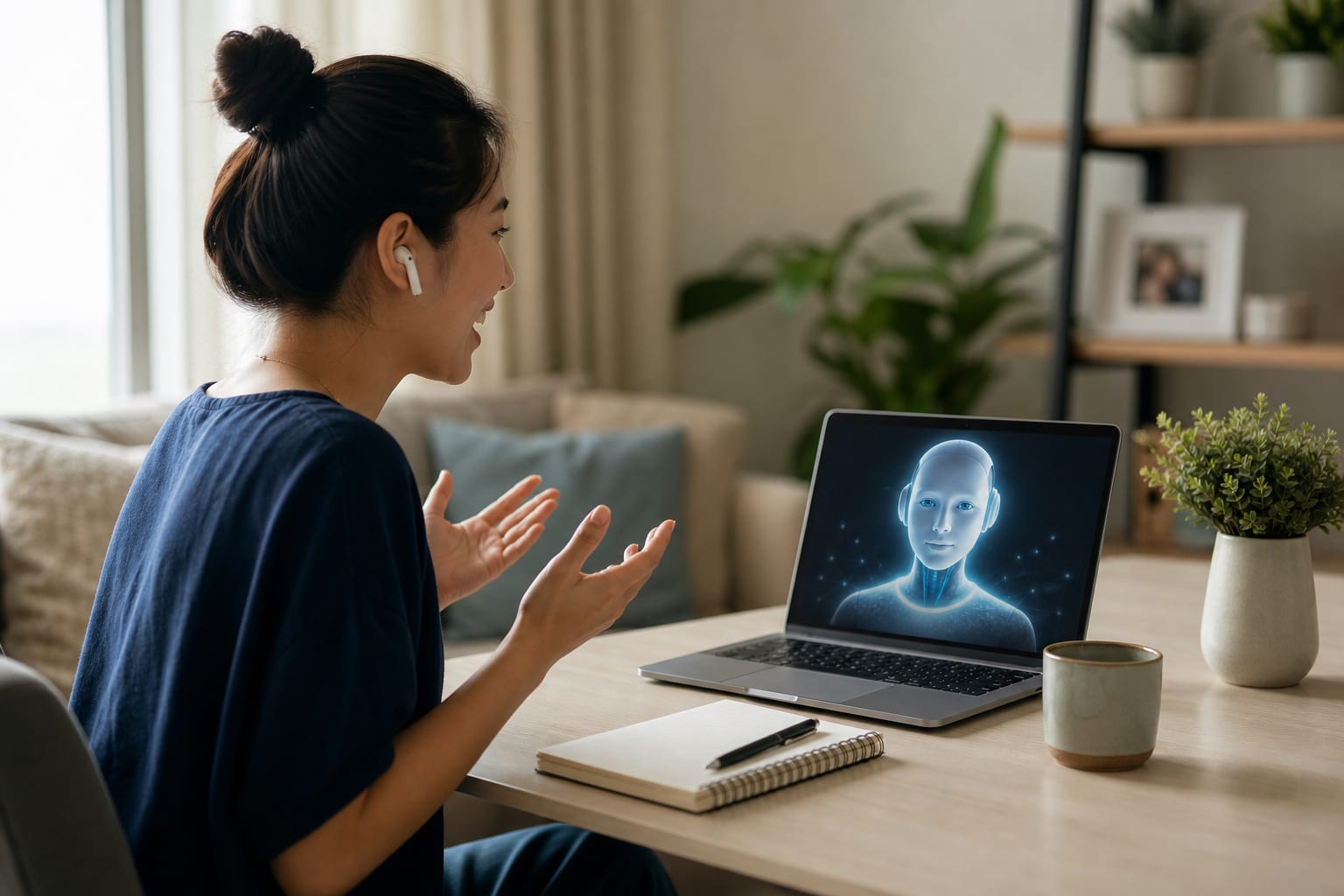
Most English learners can read a newspaper and still freeze when a cashier asks a question. The gap is not knowledge. It is that speaking is the only skill you cannot practise alone in a quiet room with a textbook, so most people simply never practise it until the moment they are forced to.
This is precisely where AI has changed the equation. A conversation partner that is always available, never impatient, and willing to hear the same sentence mangled forty times has removed the single biggest barrier to speaking practice: the fear of doing it badly in front of a person.
Why speaking is the skill most learners avoid
Reading, listening and writing all tolerate silence. You can do them alone, at your own pace, and hide your mistakes. Speaking does not allow any of that. It demands real-time production, and every error is immediately public, which is why it triggers the strongest anxiety of any language skill.
Researchers who study foreign language anxiety have documented this for decades. A study of English speaking anxiety found that higher self-reported anxiety was associated with more pauses during speech. The fear of negative evaluation, of sounding foolish in front of a teacher or a native speaker, actively reduces performance. Anxious learners produce shorter sentences, avoid complex grammar, and remember less of what they study, not because they know less, but because their working memory is occupied by self-monitoring.
This creates a cruel loop. You avoid speaking because you are afraid, so you never improve, so you stay afraid. The only way out is volume: hundreds of low-stakes speaking minutes where mistakes cost you nothing. That is the exact condition a machine can provide, and a human conversation partner rarely can, because humans get tired, bored, or politely impatient.
How AI can help you practise English speaking
Let us be precise, because there is a lot of vague marketing around AI language tools. What modern speech-enabled AI can genuinely do is three things, and they map neatly onto what speaking practice requires.
First, it listens and responds to what you actually said, not to a script. This is the difference between speaking and reading aloud. When you answer a question in your own words and the AI follows up on your answer, you are producing language, and production is what builds fluency. Second, it scores your pronunciation at the word level, flagging exactly which word came out wrong rather than giving you a vague "good job". Third, it is infinitely patient, which removes the time pressure that makes learners panic and default to their safest, simplest sentences.
None of this replaces a human. It changes the economics of practice, though. A human tutor costs money per hour and has limited patience for repetition. An AI tutor costs nothing per minute and will happily run the same drill with you every single day. For the volume of speaking that fluency actually requires, that matters enormously.
The three ways AI corrects you mid-conversation
Correction is where speaking practice either works or fails. Correct too little and errors fossilise. Correct too much and the learner shuts down. The best AI speaking tools thread this needle in three specific ways.
The first is live pronunciation scoring. As you speak, each word is marked good, fair or poor. You see immediately that "comfortable" came out as three syllables instead of four, and you can say it again until it lands. This is feedback a human tutor gives inconsistently, because a human will often let small mispronunciations slide to keep the conversation flowing. The machine never lets them slide, and that consistency is precisely what erases a fossilised error.
The second is reformulation. When you produce a sentence that is grammatically broken but understandable, a good AI tutor repeats your idea back correctly, giving you the corrected version to hear and then reuse. This is the technique linguists call a recast, and it is one of the most effective corrections in language acquisition research because it does not interrupt the flow of meaning.
The third is targeted follow-up. If you consistently misuse the past perfect, the AI notices the pattern and brings it back in a later lesson, inside a new conversation, rather than lecturing you about it on the spot. This turns correction from a one-off event into a system.
This is the design behind Tutoro, where the tutor runs the whole lesson inside a messenger-style conversation. Dictation, word banks and pronunciation scoring arrive as messages in the thread, so practice and talking are the same activity rather than separate tabs you have to switch between. The weak words and grammar gaps you expose in conversation are tracked, and they resurface on their own in later lessons.
How to build a daily speaking routine with AI
Having the tool is not the same as having the habit. The learners who actually improve are the ones who turn AI speaking practice into a daily, fixed routine, and the structure they use is remarkably consistent.
Start short. Ten to fifteen minutes of spoken conversation a day beats a two-hour session once a week, because fluency is built by frequency of retrieval, not by marathon sessions. Your brain consolidates what you produced yesterday while you sleep, and a daily touch keeps the pathways warm. Set the bar low enough that you never skip it.
Speak out loud, always. It sounds obvious, but many learners type to AI tools and call it speaking practice. Typing exercises a different skill entirely. If you are not producing sound, you are not training your mouth, your breath control, or the automatic retrieval of words under time pressure. Put headphones on, find a room where you can talk, and actually talk.
Do not prepare in advance. The temptation is to think about what you will say before each reply, but that defeats the purpose. Real conversation does not give you planning time. Let yourself answer badly. Fumbling for a word, pausing, and recovering is the workout. If you script everything first, you are practising writing, not speaking.
Finally, let the corrections accumulate rather than chasing perfection in the moment. Say the sentence, note the red word, try it once more, and move on. The AI will bring the weak items back. Your job is volume, not polish.
Tutoro gives you a tutor you can speak to on screen: a live 3D character speaks and reacts while a lesson unfolds in a chat thread. That makes daily speaking practice feel more like a conversation. When you speak, the app scores pronunciation word by word as good, fair or poor, so you can see which words need another try. It runs on Android today, giving you a way to practise regularly when a human conversation partner is unavailable.
Where AI still falls short, and how to cover it
Honesty matters here, because overselling AI speaking tools is how learners end up disappointed and quit. There are real limits, and knowing them lets you use the tool correctly instead of expecting it to be something it is not.
The biggest gap is emotional nuance. An AI tutor will not pick up on the subtle signal that you are confused but too polite to say so, and it will not adjust its warmth the way a perceptive human teacher does. If you need emotional encouragement or a sense of human connection to stay motivated, AI alone will feel hollow after a while.
The second gap is cultural and pragmatic subtlety. AI can teach you the words and grammar of a job interview, but it cannot fully replicate the unspoken rules of a specific workplace culture, the humour, the indirectness, the way a real colleague softens bad news. For high-stakes, culturally loaded communication, a human is still better.
The third gap is accountability. An app will not be disappointed in you for skipping a week. For some learners that is a feature, but for others it means the habit quietly dies. The fix is to pair AI practice with a human element, whether that is a weekly conversation partner, a class, or simply a friend you report your streak to.
The practical takeaway is not to choose one or the other. Use AI for the daily volume, the repetition, the error correction that a human would find tedious to deliver. Use humans for the emotional, cultural and motivational layer. They are complementary, and the learners who understand that get the most out of both.
Does AI speaking practice actually stick?
The fair question to end on is whether all this low-stakes repetition genuinely transfers to real conversation. The short answer, backed by how memory and skill acquisition work, is yes, with one condition.
Speaking fluency is a retrieval skill. Every time you produce a sentence from memory under time pressure, you strengthen the neural pathway that lets you do it faster next time. This is the same principle behind spaced repetition research on vocabulary retention: active recall, repeated at intervals, is what makes knowledge durable and fast to access. AI speaking practice is essentially massed retrieval practice for spoken production, and the volume it enables is something no human schedule can match.
The condition is that the practice must resemble real speaking. If you are reading prompts, typing, or pausing to translate everything in your head, the transfer will be weak. If you are producing genuine spoken answers, under mild time pressure, with corrections arriving after the fact, then the skill you are building is the skill you need in the room.
One more point worth making. The anxiety reduction is itself a form of progress. Learners who practise speaking with an AI for a few weeks report that the act of speaking stops feeling dangerous, because they have done it hundreds of times without a negative consequence. That desensitisation carries over to real conversations, and it is arguably the most valuable thing the tool provides.
So the honest summary is this: how AI can help you practise English speaking is not by making you fluent on its own, and it will not replace the richness of talking to real people. What it will do is give you the one thing fluency is built from, which is thousands of low-stakes spoken sentences, corrected in the moment, repeated daily. That is a bigger advantage than most learners realise, because it attacks the exact place where language learning usually stalls.
Common questions
Can AI really help me improve my English speaking?
Yes. AI speaking tools listen to your actual speech, score your pronunciation word by word, and respond to what you said rather than a script. This gives you the low-stakes, high-volume speaking practice that builds fluency, without the fear of judgement that holds many learners back from practising with people.
Is practising English with AI as good as a human tutor?
For daily repetition and consistent error correction, AI is often better because it is always available and infinitely patient. For emotional nuance, cultural subtlety and motivation, a human tutor is still stronger. The most effective approach combines both: AI for daily volume, humans for the human layer.
How often should I practise English speaking with AI?
Daily, for ten to fifteen minutes, is far more effective than a long weekly session. Fluency is built by frequent retrieval of words and sentences under time pressure, and a short daily conversation keeps those pathways warm. The key is speaking out loud and answering without preparing in advance.
Does speaking practice with AI transfer to real conversations?
Yes, provided the practice resembles real speaking. If you produce genuine spoken answers under mild time pressure rather than typing or reading scripts, you are building the exact retrieval skill real conversation requires. Regular AI practice also reduces speaking anxiety, which itself carries over to real interactions.
What are the limitations of AI English speaking practice?
AI cannot fully replicate emotional awareness, cultural nuance, or the accountability of a human teacher. It will not pick up on subtle confusion or adjust its warmth the way a person would. For high-stakes, culturally loaded communication, a human is still better, which is why pairing AI with human practice works best.