Learning Tech
Preply Alternatives: AI Tutors, Apps, and Human Tutors Compared Honestly
Preply alternatives come in three main forms: AI tutors, gamified apps, and one-to-one human teachers. Each wins on different things, and the right choice depends on whether you need real speaking practice, structured feedback, or a flexible schedule. This comparison breaks down exactly where each option earns its place.
Why people leave Preply in the first place
Preply is not a bad platform. It connects you with a real human tutor, which is the single most effective way to improve spoken English. The problem is rarely the quality of the teaching. It is the cost, the scheduling, and the pressure of a live lesson.
According to Preply's English tutoring rates guide, English lessons usually cost $15 to $50 per hour. At one session a week, that is roughly $60 to $200 a month for four hours of lessons. Miss a week and the momentum breaks.
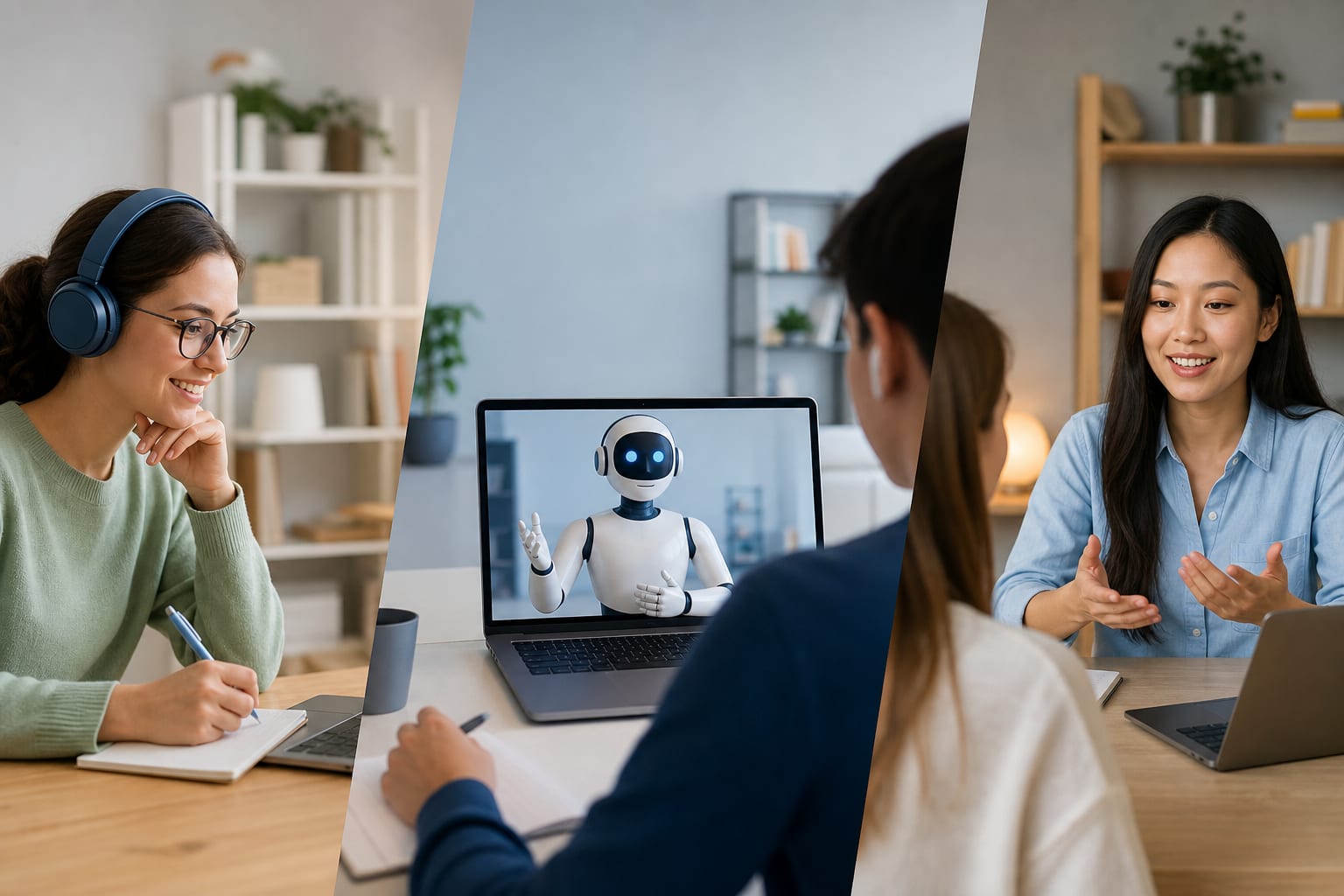
So when people search for Preply alternatives, they are usually looking for one of three things: something cheaper, something more flexible, or something that gives them speaking practice without the anxiety of performing in front of a stranger. The three main options each answer one of those needs, and each has a clear weakness.
The three real alternatives to Preply
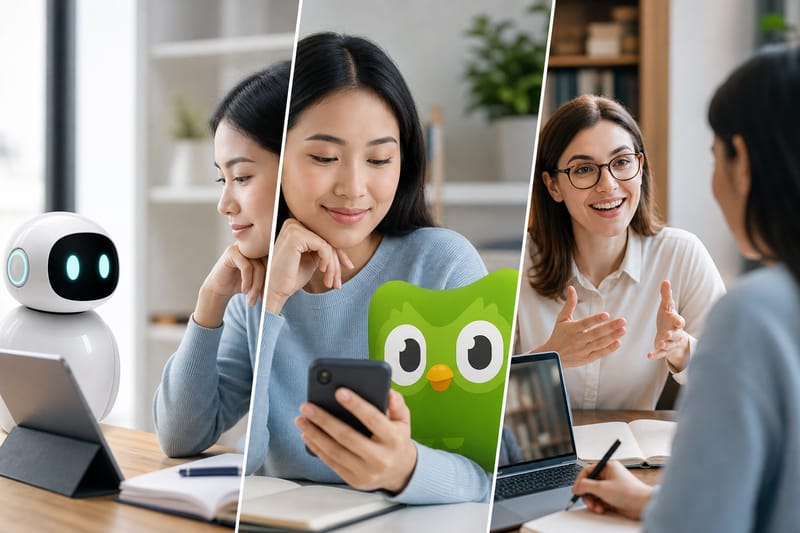
Strip away the marketing and there are exactly three categories of Preply alternative worth considering. The first is an AI English tutor, which runs a conversation with you and corrects you as you go. The second is a gamified language app, of which Duolingo is the most famous. The third is simply a different human tutor, either found independently or on another platform.
Everything else is a variation on one of these three. A language exchange partner is a human tutor who is not paid. A flashcard app is a gamified app without the speaking. An AI chatbot without a curriculum is an AI tutor with the structure removed. Understanding the three core options is enough to make a decision.
The comparison below is honest about where each one fails, because a table where one option wins every row is not a comparison, it is an advertisement. A human tutor genuinely wins on some criteria, and that is exactly what makes the rest of the table worth trusting.
| Tutoro | Duolingo | A human tutor | |
|---|---|---|---|
| Real speaking practice | Continuous conversation with a speaking, reacting 3D tutor, daily | Single-sentence pronunciation drills, no real conversation | Authentic conversation, but only 20 minutes of speaking per lesson |
| Correction and feedback | Instant word-by-word pronunciation scoring, consistent correction | Right or wrong only, no explanation of the pattern | Nuanced, level-aware correction with judgement of what matters |
| When you can practise | Anytime, any length, no booking or cancellation fee | Anytime, but exercises only, not conversation | Fixed weekly slots, paid whether you were at your best or not |
| What it costs | Flat subscription, less than one hour with a tutor per month | Free at basic tier, but it does not teach conversation | $10-40 per hour, $40-160 per month for weekly lessons |
| Structured progression | Authored CEFR curriculum with weak words resurfacing automatically | Gamified path, but no adaptive review of your weak points | Personalised plan, but depends heavily on the individual teacher |
How they compare on real speaking practice
Speaking is the skill most learners are actually trying to build, and it is where the three options diverge most sharply. A human tutor gives you the most authentic conversation possible: a real person who reacts, interrupts, and asks follow-up questions the way a native speaker would. Nothing replaces that.
But there is a catch that rarely gets said aloud. In a one-hour lesson, you might speak for 20 minutes. The rest is the tutor explaining, correcting, or setting up exercises. And you do it once a week, which means your speaking muscles get a short workout and then six days of rest.
An AI English tutor inverts that ratio. You speak for nearly the whole session, and you can do it every day. Tutoro runs its lessons as a conversation with a 3D tutor who speaks and reacts on screen, so the practice is continuous rather than intermittent. The downside is authenticity: an AI does not have the lived experience or the unpredictability of a human, and it will not tell you a story about its childhood.
Duolingo is the weakest here by design. Its speaking exercises ask you to repeat a sentence and grade it against a pronunciation model, as Duolingo's own course descriptions explain. That is pronunciation practice, not conversation. It builds confidence in saying words out loud, but it does not teach you to hold a discussion, recover from a mistake, or think on your feet.
Correction and feedback: who actually fixes your mistakes
Feedback is where a human tutor is genuinely unbeatable. A good teacher hears a mistake, understands why you made it, and explains the rule in a way that fits your level. They also know when not to correct you, because interrupting every sentence kills fluency. That judgement is hard to automate.
An AI tutor corrects differently. It catches grammar and word choice instantly and consistently, which a human cannot always do mid-conversation. Tutoro scores your pronunciation word by word as you speak, marking each one good, fair or poor in real time. The feedback is immediate and never misses a session. What it lacks is the human intuition for which mistakes matter most and which ones to let slide.
Duolingo's feedback is the thinnest of the three. It tells you right or wrong, and it will show you the correct answer, but it does not explain the underlying pattern or remember that you keep making the same error. It is a grader, not a teacher.
What availability really means
Availability is not just about time zones. It is about whether you can practise at 11pm on a Tuesday, whether you can do ten minutes or need to block out an hour, and whether there is a cost to cancelling. On all three counts, an AI tutor is the most flexible option available.
A human tutor works on a schedule. You book a slot, you show up, and you pay whether you were at your best or not. If you can only study late at night or in short bursts, a weekly lesson is a poor fit. Duolingo is available anytime, but you are doing exercises, not conversing.
An AI English tutor splits the difference. Tutoro is available whenever you open it, with no booking and no cancellation fee, and its lessons run for as long as you have. That makes it the only option on this list that supports daily practice for someone with an unpredictable schedule. The trade-off is that the tutor is not a person, which matters if you learn best through human connection.
What each option costs
Cost is the most straightforward comparison, and the numbers tell a clear story. A human tutor is the most expensive option by a wide margin. Duolingo is effectively free at its basic tier. An AI tutor sits in the middle, and in most markets it costs less per month than a single hour with a human teacher.
But price per month is the wrong way to think about it. The right question is cost per minute of actual speaking practice. A $20 weekly lesson gives you roughly 20 minutes of speaking for $20, or about a dollar per minute. An AI tutor used for 20 minutes a day gives you 600 minutes a month for a flat subscription, which changes the calculation entirely.
Duolingo wins on raw price and loses on relevance. Free vocabulary and grammar drills have value, but they are not the skill you were paying Preply to develop. If your goal is conversation, the free option is free because it is not teaching conversation.
Who each option is actually for
After all of that, the honest recommendation is that these three options are for three different people, and sometimes for the same person at different stages. A human tutor is right if you are preparing for a high-stakes exam, need nuanced feedback on writing, or simply learn best through a relationship with a teacher. There is no substitute for a person who knows you.
Duolingo is right if you are a complete beginner building your first few hundred words, or if you want a low-effort daily habit that keeps English in your day. It is a supplement, not a replacement for speaking practice, and treating it as more than that is how learners plateau at the intermediate level.
Tutoro is built for the middle: learners who need daily speaking practice but cannot justify the cost or schedule of a weekly human tutor. Its lessons run entirely as a conversation, with a 3D tutor who speaks and reacts on screen, and every word you say is scored for pronunciation as you say it. It also remembers your weak words and brings them back on their own. It does not suit learners who need a human relationship or exam-level writing feedback.
For most intermediate learners, the strongest combination is an AI tutor for daily volume and a human tutor for a monthly check-in. That gives you the quantity of practice that builds fluency and the quality of feedback that fixes persistent errors, without paying for a person to sit through the repetition a machine can handle.
Frequently asked questions
Is an AI tutor as good as a human tutor for learning English?
For daily speaking practice and instant correction, an AI tutor can match or exceed a human tutor on frequency and consistency. For nuanced feedback, cultural context, and exam preparation, a human tutor is still better. Many learners use both: an AI tutor for daily volume and a human for periodic check-ins.
What is the cheapest effective alternative to Preply?
An AI English tutor is typically the cheapest option that still provides real conversation practice. Duolingo is free but does not teach conversation. A single hour with a human tutor often costs more than a full month of an AI tutor subscription, making the AI option the best value for learners on a budget.
Can Duolingo replace a tutor for speaking practice?
No. Duolingo's speaking exercises grade pronunciation of single sentences, which is useful for confidence but does not develop conversational fluency. It cannot hold a discussion, adapt to your level in real time, or correct grammar in context. It works best as a supplement for vocabulary and basic structure.
How often should I practise speaking to improve?
Research on language acquisition suggests regular output matters more than long infrequent sessions. Twenty minutes of speaking most days beats one hour a week, because retrieval and production reinforce what you have learned. This is why a flexible AI tutor, used daily, can outperform a weekly human lesson for fluency building.
Do I still need a human tutor if I use an AI tutor?
Not necessarily, but it helps for specific goals. If you are preparing for an exam like IELTS or need feedback on formal writing, a human tutor adds value an AI cannot fully match. For general fluency and confidence, an AI tutor used consistently may be sufficient on its own.
Common questions
Is an AI tutor as good as a human tutor for learning English?
For daily speaking practice and instant correction, an AI tutor can match or exceed a human tutor on frequency and consistency. For nuanced feedback, cultural context, and exam preparation, a human tutor is still better. Many learners use both: an AI tutor for daily volume and a human for periodic check-ins.
What is the cheapest effective alternative to Preply?
An AI English tutor is typically the cheapest option that still provides real conversation practice. Duolingo is free but does not teach conversation. A single hour with a human tutor often costs more than a full month of an AI tutor subscription, making the AI option the best value for learners on a budget.
Can Duolingo replace a tutor for speaking practice?
No. Duolingo's speaking exercises grade pronunciation of single sentences, which is useful for confidence but does not develop conversational fluency. It cannot hold a discussion, adapt to your level in real time, or correct grammar in context. It works best as a supplement for vocabulary and basic structure.
How often should I practise speaking to improve?
Regular output matters more than long infrequent sessions. Twenty minutes of speaking most days beats one hour a week, because retrieval and production reinforce what you have learned. This is why a flexible AI tutor, used daily, can outperform a weekly human lesson for fluency building.
Do I still need a human tutor if I use an AI tutor?
Not necessarily, but it helps for specific goals. If you are preparing for an exam like IELTS or need feedback on formal writing, a human tutor adds value an AI cannot fully match. For general fluency and confidence, an AI tutor used consistently may be sufficient on its own.