Learning Tech
The Best AI for Learning English: Tutoro, Duolingo or a Human Tutor?
Choosing the best AI for learning English means weighing real speaking practice against convenience and cost. This comparison puts Tutoro, Duolingo and a human tutor side by side on the five things that actually decide whether you improve.
Why most English learners stall
Most people who study English for years can read it, write it and pass a grammar test. What they cannot do is hold a conversation. The gap is not knowledge. It is that they have almost never produced the language under real pressure, out loud, with someone reacting to what they said.
This is where the question of the best AI for learning English becomes practical rather than theoretical. A tool that only shows you vocabulary and asks you to tap the right word is training recognition. A tool that makes you speak, and then tells you which words you mispronounced, is training production. Those are different skills, and only the second one gets you fluent.
So when people ask which option is best, the honest answer is that it depends on what has been blocking them. The rest of this article compares three realistic choices: Tutoro, Duolingo, and a human tutor. Each has a clear winner in certain situations, and I will say plainly which one wins each criterion.
What makes the best AI for learning English?
A good AI English tutor does not just answer questions. It runs a lesson. It introduces new language, gives you a chance to use it, listens to what you produce, and adjusts what comes next based on your mistakes. That is the difference between a chatbot and a teacher, and it matters more than any feature list.
Three things separate a useful AI tutor from a gimmick. First, it has to make you speak. Second, it has to correct you specifically, not generically. Third, it has to remember what you got wrong and bring it back later. If any of those three is missing, you are using a vocabulary quiz with a chat window attached.
This is also why the comparison below is not a feature checklist. Features are easy to add and easy to ignore. The five criteria that follow are the ones that determine whether you actually improve: speaking, feedback, availability, price and progression.
Tutoro vs Duolingo vs a human tutor
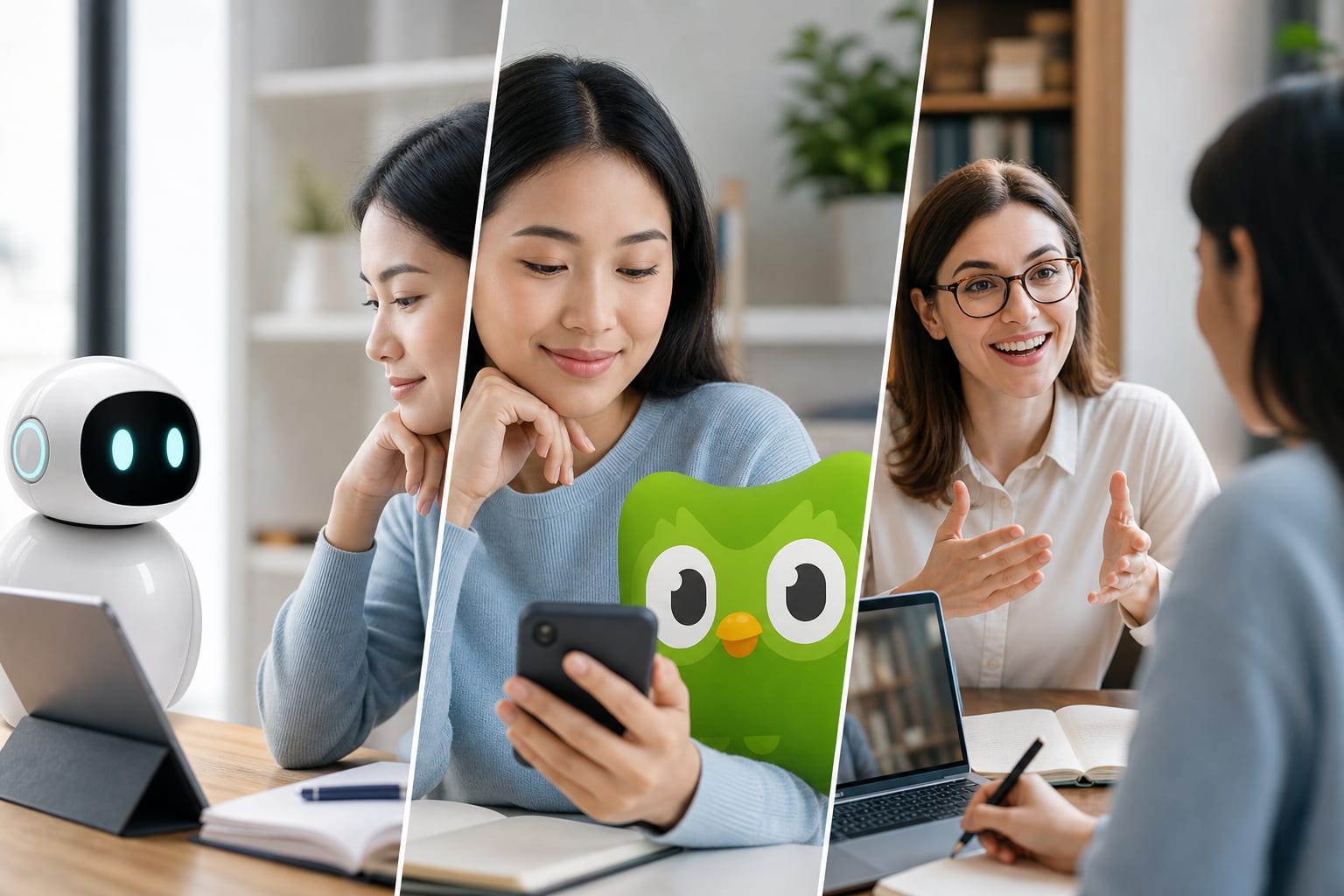
Before the detail, here is the shape of the argument. Duolingo is excellent at building a daily habit and costs nothing, but it does not make you speak in any meaningful sense. A human tutor gives the deepest, most personal feedback, but costs more than most learners can sustain and is only available in fixed slots. Tutoro sits between them: it makes you speak and scores your pronunciation word by word, it adapts to your mistakes automatically, and it is free to use with a subscription to remove limits.
The table below summarises the five criteria. The sections after it explain each one properly, because a table can only ever tell you what, not why.
| Tutoro | Duolingo | A human tutor | |
|---|---|---|---|
| Real speaking practice | Real conversation with an AI tutor that speaks, listens and reacts; free-talk chats | Repeats memorised phrases; no conversation or follow-up | Genuine two-way conversation, but limited to booked lesson hours |
| Correction and feedback | Word-by-word pronunciation scoring; weak words and grammar resurface on their own | Right or wrong answers with occasional grammar notes; no detailed speech correction | Deep, personal diagnosis of mistakes and why they happen |
| When you can practise | Practise any hour, any day, in spare minutes or longer sessions | Always available, ideal for short daily habit sessions | Fixed appointment slots that life regularly disrupts |
| What it costs | Free with an energy meter; subscription removes limits and unlocks tutors | Free with ads; paid tier removes ads and adds extras | Fifteen to fifty dollars an hour, hundreds a month for real volume |
| Structured progression | Authored course set by a spoken placement test, plus adaptive review of weak items | Clear fixed path of units, but generic and not adapted to your mistakes | Personalised when planned, but often drifts into unstructured conversation |
Real speaking practice
Speaking is where the three options diverge most sharply. Duolingo's speaking exercises ask you to repeat a short sentence and check whether the words were roughly recognisable. There is no conversation, no follow-up question, and no one reacting to what you said. It is pronunciation checking attached to memorised phrases, not speaking.
A human tutor is the gold standard here. You talk, they listen, they respond naturally, and the conversation can go anywhere. The limitation is volume: a one-hour lesson a week gives you roughly fifty minutes of talking time, minus the tutor's own speaking and any explanations. That is not enough on its own to build fluency, which is why most learners who rely solely on a weekly lesson stay stuck for years.
Tutoro approaches speaking differently. The lesson itself is a conversation with an AI tutor: a 3D character speaks, listens and reacts while the lesson runs, and the learner replies in free text or speech rather than tapping multiple-choice answers. There are also free-talk and scenario chats for anyone who just wants to talk, including one where you write the scenario yourself. The volume is the point. You can talk for twenty minutes a day, every day, without booking anyone.
Correction and feedback
Feedback quality is where a human tutor genuinely wins, and I will not pretend otherwise. A good teacher hears a mistake, understands why you made it, and explains it in a way that fits your level and your first language. That kind of diagnosis is hard to automate, and no AI does it perfectly.
What Duolingo offers is closer to an answer key. It tells you whether your answer was right or wrong, and occasionally shows a grammar note. It does not listen to your speech closely enough to correct individual sounds, and it does not explain your particular mistake. It is feedback in the sense that a traffic light is feedback.
Tutoro occupies the middle ground, and it is stronger than most people expect. Pronunciation is scored word by word as you speak, with each word marked good, fair or poor, so you know exactly which sound failed rather than just that the sentence was wrong. Grammar gaps and weak vocabulary are tracked continuously and resurface later on their own. What it cannot do, and what a human still does better, is explain why a subtle phrasing sounds unnatural to a native ear.
Tutoro puts English practice inside a messenger-style lesson. Dictation, word-bank exercises and comprehension questions arrive in the conversation, and the AI tutor reads your replies before adapting what comes next. It also tracks weak vocabulary and grammar gaps, bringing those items back in later lessons without a deck to manage. That gives learners a way to practise and revisit trouble spots within the same conversation.
When you can practise
Availability is the quiet killer of learning plans. A human tutor works in fixed slots: you book, you show up, and if you are tired or busy, the hour still passes. Most learners manage one or two sessions a week, and life regularly eats one of them. Consistency, not intensity, is what builds language, and an appointment-based schedule makes consistency fragile.
Both apps are available whenever you are, which is their shared advantage. The difference is what you can do in that time. Duolingo's sessions are short and structured around a streak, which is genuinely effective for keeping a daily habit alive. The AI tutor's sessions are conversations, which means a spare ten minutes can be spent actually speaking rather than tapping through a lesson.
The practical effect is that an AI tutor turns dead time into practice time. A commute, a lunch break, ten minutes before bed. None of those fit a scheduled lesson with a person, but all of them fit a conversation with an AI that is ready at any hour.
What it costs
Cost is the clearest criterion in the whole comparison, and the numbers are not close. A private English tutor typically charges between fifteen and fifty dollars an hour depending on the country and the tutor's experience. A committed learner wanting three sessions a week is looking at hundreds of dollars a month, sustained for years. That is out of reach for most people, which is exactly why app-based learning took off.
Duolingo is free, supported by advertising, with a paid tier that removes ads and adds a few extras. Tutoro is also free to use, metered by an energy bar that refills over time, with a subscription that removes the energy limit, unlocks every tutor and adds a currency bonus. Neither charges per lesson, which changes the economics of practice entirely: you can practise daily without watching a meter run.
The honest caveat is that free access is not the same as unlimited access. Both apps meter free use in different ways, and a human tutor has no meter at all, only a bill. For most learners, the app model is the only one that makes daily practice financially possible.
Structured progression
Progression is where apps have quietly overtaken many human tutors. A good tutor plans your lessons, but the plan lives in their head and rarely survives contact with a busy schedule. Many private lessons drift into pleasant conversation with no clear arc, which feels good and improves little.
Duolingo's structure is its strongest asset: a clear path of units and levels that keeps you moving forward and tells you exactly where you are. The weakness is that the path is fixed and generic, and it does not adapt to your personal mistakes beyond simple repetition.
Tutoro's structure is authored rather than improvised. Onboarding begins with a short spoken placement conversation that finds your CEFR language proficiency level and hears you speak once, then assigns you a reviewed course at that level, so nothing arrives out of order and nothing is taught twice. On top of that, your weak and strong vocabulary, grammar gaps and trouble spots are tracked continuously, and weak items resurface on their own. There is also a difficulty ladder: a word you have already produced in free conversation never comes back as a recognition exercise, so practice moves forward instead of going in circles.
Who should choose which?
If your budget is generous and you need native-level nuance, a human tutor is worth it, and no app replaces one. If your goal is to build a daily habit and you are a complete beginner who needs a low-stakes on-ramp, Duolingo does that well and for free. But if your specific problem is that you freeze when you have to speak, the answer is volume of speaking practice, and that is where an AI tutor earns its place.
Most learners do not actually need to choose one forever. A common and sensible pattern is an AI tutor for daily speaking volume, plus a human tutor once a week or once a fortnight for the nuanced feedback only a person can give. The two are not rivals in that setup; they cover each other's weakness.
What matters is that you stop treating recognition practice as speaking practice. If the tool you use never makes you produce a sentence out loud and never tells you which word you said wrong, it is not teaching you to speak, whatever its marketing says. The best AI for learning English is the one that closes that specific gap.
Frequently asked questions
These are the questions readers ask most after comparing the options. Each answer stands alone.
Common questions
Is an AI tutor better than Duolingo for learning English?
For speaking, yes. Duolingo builds vocabulary and grammar recognition and is excellent for forming a daily habit, but its speaking exercises only check whether a memorised phrase was roughly recognisable. An AI tutor that runs real conversations and scores your pronunciation word by word trains production, which is the skill Duolingo does not develop.
Can an AI tutor replace a human English teacher?
Partly. An AI tutor can replace the daily speaking volume and structured progression that a human teacher cannot provide at a sustainable price. It cannot yet match a skilled human's ability to explain subtle, native-level phrasing or diagnose why a specific sentence feels unnatural. Many learners combine both: AI for daily practice, a human for nuanced feedback.
How much does a human English tutor cost compared to an app?
A private English tutor typically charges between fifteen and fifty dollars an hour, so three sessions a week can cost several hundred dollars a month. Apps like Duolingo and Tutoro are free to use with optional subscriptions, which makes daily practice financially realistic for most learners. The app model removes the per-lesson cost entirely.
What should I look for in an AI for learning English?
Look for three things: it must make you speak out loud, it must correct you specifically rather than generically, and it must remember your mistakes and bring them back later. If an AI only shows vocabulary and asks you to tap the right answer, it is training recognition, not the production skill that leads to fluency.
Is Tutoro free to use?
Yes. Tutoro is free to use, metered by an energy bar that refills over time. A subscription removes the energy limit, unlocks every tutor and adds a currency bonus. There is no per-lesson charge, so you can practise daily without watching a cost meter run, which changes the economics of speaking practice entirely.